WAR IS NOT A GAME — DISARMED ART
THE STATEMENT

WAR IS
NOT A GAME

Some people inherit photographs.
Others inherit silence.

Long after the gunfire stops, wars continue to exist in memories, in fears, in habits, and in the quiet stories that are never fully told. Many children and grandchildren grow up sensing that something happened, even when no one can find the words to explain it.

A parent who never speaks about captivity.
A grandparent who still stockpiles food decades after peace has returned.
A family that instinctively fears the sound of sirens.
A generation carrying emotions that were never theirs to begin with.

Violence rarely ends when a treaty is signed. It echoes through families and communities, shaping lives in ways that often remain invisible.

We come from different countries, are from different generations, and have different life experiences. Yet we discovered that our families carried remarkably similar stories. Different languages. Different histories. The same scars.

That realization became the beginning of DISARMED ART.

Today, war is increasingly consumed as entertainment. Images of destruction are edited like movie trailers. Military operations are given dramatic names. Bombings become social media content. Fictional heroes are placed beside real violence. Digital culture can make unimaginable suffering appear distant, exciting, even heroic.
But war is
not a game.

Every explosion changes lives that cannot be restored with a reset button. Every weapon carries consequences long after it has fallen silent.

DISARMED ART exists to challenge that reality.

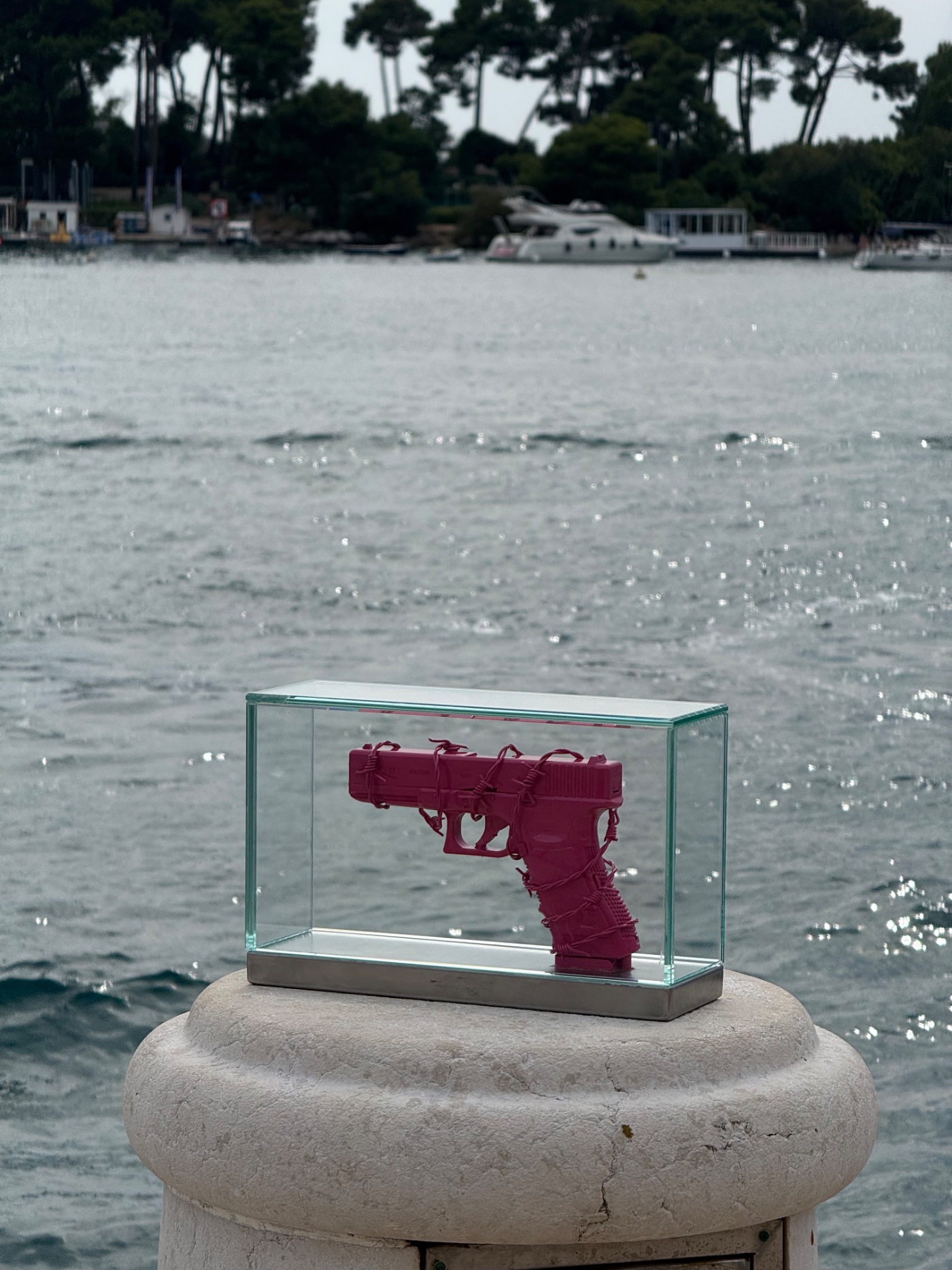
Each sculpture begins with an object designed to intimidate, control, or destroy. It is permanently stripped of its original purpose, transformed, and preserved inside transparent glass. Unable to harm again, it becomes something entirely different: a conversation.

It allows people to pause, observe, question, and reflect.

Around the world, the color pink is often associated with compassion, hope, vulnerability, and humanity. In an object once created for violence, it creates a visual contradiction that demands attention. The sculpture asks a simple question:

What if the strongest response to violence is not more violence, but the courage to transform it into hope?
DISARMED ART is not about politics.
It is not about choosing sides.
It is not about glorifying weapons.

It is about remembering the human cost of every conflict and recognizing that violence leaves marks that often outlive those who experienced it.

Our work represents the belief that objects can lose their original purpose and gain a new one.

A weapon can become a reminder.

A symbol of fear can become a symbol of hope.

An instrument of violence can become an invitation to empathy.

Art cannot stop a war.
But art can stop someone.
It can make them pause.
It can make them feel.
It can start conversations that statistics and headlines never could.

Peace does not begin when the last shot is fired. Peace begins when we choose not to pass on violence to the next generation.

As long as war continues to be presented as entertainment, we will continue transforming its symbols into works that represent the opposite.

Not destruction.Reflection.
Not hatred.Humanity.
Not war.Hope.

That is the purpose of DISARMED ART.

The art of disarming. Not only weapons… but fear, hatred, and division as well.

© JOSSELINE & PROXY
DISARMED N°0 above open water

See the first work.

DISARMED N°0 — a 1:1 pistol replica, disarmed, bound in pink barbed wire, sealed under glass on solid inox.